بسم الله والحمد لله والصلاة والسلام على رسول الله ، وبعد
By: Shaikh Sa`eed Ibn `Alee Ibn Wahf al-Qahtaanee رحمه الله.
بسم الله والحمد لله والصلاة والسلام على رسول الله ، وبعد
By: Shaikh Sa`eed Ibn `Alee Ibn Wahf al-Qahtaanee رحمه الله.
بسم الله والحمد لله والصلاة والسلام على رسول الله ، وبعد
By: Shaikh Sa`eed Ibn `Alee Ibn Wahf al-Qahtaanee رحمه الله.
Introduction To Hisnul-Muslim
(By The Author)
الذكر والدعاء والعلاج بالرقى من الكتاب والسنة
Al-Dhikr wad-Du`aa
wal-`Ilaaj bir-Ruqaa minal-Kitaab was-Sunnah [2]
In order to make it small and easily portable, I have chosen
only the section on words of remembrance for this abridgment. To achieve this,
I only mentioned the text of the words of remembrance instead of the entire
Hadeeth. I also limited myself to mentioning only one or two reference from the
original book for each Hadeeth. Whoever would like to know about the Companion
who related a particular Hadeeth, or more information about where it is recorded,
should refer to the original work [mentioned above].
I ask Allaah, the Glorious, the Mighty, by His beautiful
Names and by His sublime Attributes to accept this as having been done
sincerely for His sake alone. I ask Him to bring me its benefits during my
lifetime and after my death. May those who read it, those who print it, or have
had any role in its distribution, benefit from it also. Surely, He, the
Glorified, is Capable if all things. May the peace and blessings of Allaah be
upon our Prophet, Muhammad, and upon his family and Companions, and whoever
follows them in righteousness till the Day of Judgment.
By:
Sa`eed Ibn `Alee Ibn Wahf al-Qahtaanee
Safar, 1409H
[1]
Hisnul-Muslim min Adhkaar al-Kitaab was-Sunnah, seventeenth edition printed in
the month of Dhul-Qa`dah, 1416H.
[2]
This book (Al-Dhikr wad-Du`aa wal-`Ilaaj) has been printed many times, and all
praise is for Allaah alone. And the author has extracted the Ahaadeeth and cited
the references in the third edition, in four volumes.
بسم الله والحمد لله والصلاة والسلام على رسول الله ، وبعد
❝They say:
“You don’t know what you
have until it’s gone.”
But the truth is:
“You knew exactly what you had. You just
didn’t think you’d lose it…”❞
🌴🌴🌴
🌟 The Pain Of Moving On
After Getting Used To A Comfortable Life/Place/Situation:
The comforts in life come in different shapes and sizes.
People love having luxurious homes, comfortable cars, lots of wealth, beautiful
wives and children, big farms, etc. As Allaah تعالى mentioned:
زُيِّنَ لِلنَّاسِ حُبُّ الشَّهَوَاتِ مِنَ النِّسَاءِ
وَالْبَنِينَ وَالْقَنَاطِيرِ الْمُقَنطَرَةِ مِنَ الذَّهَبِ وَالْفِضَّةِ وَالْخَيْلِ
الْمُسَوَّمَةِ وَالْأَنْعَامِ وَالْحَرْثِ ۗ ذَٰلِكَ مَتَاعُ الْحَيَاةِ
الدُّنْيَا ۖ وَاللَّهُ عِندَهُ حُسْنُ الْمَآبِ
{Beautified for men is the
love of things they covet; women, children, much of gold and silver (wealth),
branded beautiful horses, cattle, and well-tilled land. This is the pleasure of
the present world's life; but Allaah has the excellent return (Paradise with
flowing rivers, etc.) with Him.} [1]
But the thing is that not only did our hearts get attached
to the comforts of this life, rather, we also got comfortable with sins. And
every sin, if not repented, comes with a price, and now we are paying the
price... loss of lives, health, jobs, and wealth, the ever-increasing expenses,
the insecurity about what the future holds, the uncertainty of the next move,
and the indecisiveness about the next step.
1. The Reason For The Conflict
2. The Treachery Of Hamas
3. The Treachery Of The Jews (Zio∙Nists)
A) The Prophet
Killers
B) Jewish Propaganda
C) The Jews: The Originators
Of The Art Of Deception
4. The Zio∙Nist
Sympathizers Among The Muslims (See The Screenshots)
A) Ibn Taymiyyah: “They
Are The Mules Of The Jews”
B) Nullifier Of Islaam:
Supporting The Kuffaar Against The Muslims
C) Hypocrites And Masjid
Al-Dhiraar
5. Permissibility Of Making Truce With The Jews
6. What Should We Do As Muslims
A) Reflect On Our
Own Situation
(Or The Trials Through Prosperity And Poverty)
﴿كُلُّ نَفْسٍ ذَآئِقَةُ الْمَوْتِ
وَنَبْلُوكُم بِالشَّرِّ وَالْخَيْرِ فِتْنَةً وَإِلَيْنَا تُرْجَعُونَ﴾
{Everyone is going to taste
death, and We shall test you with evil and with good by way of trial. And to Us
you will be returned} [Surah
al-Anbiyaa (21): 35]
Ibn Rajab رحمه الله commented,
saying:
“Allaah تعالى has made everything
that afflicts a person – either good or bad – a Fitnah (trial), meaning it is a
calamity by which everyone will be put to test.
بسم الله والحمد لله والصلاة والسلام على رسول الله ، وبعد
By: Shaikh Sa`eed Ibn `Alee Ibn Wahf al-Qahtaanee رحمه الله.
Introduction by the Author:
Shaikh Sa`eed Ibn `Alee Ibn Wahf al-Qahtaanee رحمه الله said:
بسم الله والحمد لله والصلاة والسلام على رسول الله ، وبعد
By: Shaikh Sa`eed Ibn `Alee Ibn Wahf al-Qahtaanee رحمه الله.
Introduction by the Translator:
The Book “Hisn al-Muslim” (حصن المسلم – Fortress Of The Muslim) needs no introduction. It has become a household name for every Muslim who loves the authentic Sunnah. For the past few decades, it has been a go-to book for many Muslims who wanted to learn the authentic Ad`iyah (sing. Du`aa, supplications) and Adhkaar (Allaah’s remembrance) that are intended to be said at certain times and places.
بسم الله والحمد لله والصلاة والسلام على رسول الله ، وبعد
⚡️What is "al-Hajj al-Akbar"?
⚡️Does the reward for al-Hajj increases if it falls on a Friday?
👉PART 1:
🚫 The Weak/Baseless narrations about the "merit" when the Day of al-`Arafah comes on a Friday - which people wrongly consider as "al-Hajj al-Akbar" or that it has special virtues:
1️⃣ “The best day on which the sun has risen is the Day of `Arafah which coincides with Friday, (performing Hajj) in it is better than Seventy Hajjs performed in other days.”
📚 [Silsilah al-Hadeeth al-Dha`eefah (1193, 3144). Shaikh al-Albaanee said: “This Hadeeth is Baatil (baseless) and has no origin.”]
بسم الله والحمد لله والصلاة والسلام على رسول الله ، وبعد
From Shaikh Muhammad al-Malki’s lecture (summarized):
1. The favors and blessings of Allaah upon us are too many, we can neither count them nor can we thank Him fully for them.
2. Yet we are obliged to thank Him for these favors, because
thanking Him for these favors only helps in increasing them, as Allaah تعالى said:
بسم الله والحمد لله والصلاة والسلام على رسول الله ، وبعد
All praise is for Allaah (alone), and the most perfect and
complete prayers and peace be upon Muhammad, the Messenger of Allaah, the preeminent
amongst the first and the last (of the descendants of `Aadam), and the Imaam of
the Prophets and Messengers, the (first) one who will intercede and (the first
one) whose intercession will be accepted on the Day of Judgment, and upon his
nice family, and his pure wives – the mothers of the Believers, and his noble
Companions, and upon those who follow his Sunnah and accepts his guidance till
the Day of Judgment.
To proceed…
The Prophet ﷺ
said: “There are no days in
which good deeds are more beloved to Allaah than these days.”
(Meaning the first ten days of Dhul-Hijjah). They (the Companions) asked: “Not
even Jihad?” He ﷺ replied: “Not
even Jihad, except that of a man who does it by putting himself and his
property in danger (for Allaah's sake) and does not return with any of those
things.”
[Sunan Abu Dawood
(2348), Sunan al-Tirmidhee (757), Sunan Ibn Maajah (1727), and graded as
“Saheeh” by Shaikh al-Albaanee. Imaam al-Bukhaaree also reported in his Saheeh
(969) with a slight different wording]
بسم الله والحمد لله والصلاة والسلام على رسول الله ، وبعد
👉 Always remember, the
tongue is the reflection of the heart, while the actions are the reflection of
the person’s character.
🔥 As for the tongue being
the reflection of the heart, Allaah تعالى
said about the Jews and the Mushriks:
قَدْ بَدَتِ الْبَغْضَاءُ مِنْ أَفْوَاهِهِمْ وَمَا
تُخْفِي صُدُورُهُمْ أَكْبَرُ
{Hatred has already appeared
from their mouths, but what their breasts conceal is far worse.}
📚 [Surah aal-`Imraan
(3):118]
🔥 As for the actions
being the reflection of a person’s character, the Prophet ﷺ
said:
❝If you have no shame then do what you like.❞
📚 [Saheeh al-Bukhaaree
(3483, 3484, 6120)]
بسم الله والحمد لله والصلاة والسلام على رسول الله ، وبعد
🌟 The three types of
trials:
1. Trails for elevating the
status
2. Trials as a reminder
3. Trials as a punishment
👉 Foremost, you must
realize that you were not created for this world. You were created for the
Hereafter. Either the permanent bliss in Paradise or the painful punishment in
the Hellfire.
💠 THE FIRST TYPE OF PEOPLE:
(Trails for elevating the status)
Perhaps a person may be righteous. His relationship with Allaah is good, upon servitude, obedience, and righteousness, and his sins are less, he is obedient to his parents, he strictly guards the prayers, prays on time, recites the Qur’aan, etc. All his affairs are good! Yet, after all this, he is afflicted with sickness or falls into debt, or loses his job, and he lives in poverty and destitution. He supplicates and supplicates, but it seems to him that his prayers are not being answered.
بسم الله والحمد لله والصلاة والسلام على رسول الله ، وبعد
Allaah تعالى said in the Glorious
Qur’aan:
وَإِمَّا يَنْزَغَنَّكَ مِنَ
الشَّيْطَانِ نَزْغٌ فَاسْتَعِذْ بِاللَّهِ إِنَّهُ سَمِيعٌ عَلِيمٌ
{And if an evil whisper comes to you from Shaitaan then seek refuge with Allaah. Verily, He is All-Hearer, All-Knower.}
📚 [Surah al-A`raaf (7):
200, and Surah al-Fussilat (41): 36]
🌴🌴🌴
👉 At any time, and in any
situation, {if a prompting from Shaitaan stirs
you up} that is, you feel angry or you feel Shaitaan’s whispering
and discouragement from doing good, or encouragement and prompting to do evil,
then seek Allaah’s protection, for He hears all things, and He is aware of all
that is taking place.
📚 [Tafseer al-Muyassar
(7):200]
🌴🌴🌴
👉 Al-Tabaree mentioned in
his Tafseer:
The root meaning of the word al-Nazgh (النزغ)
is al-Fasaad (corruption). It is when Shaitaan stirs animosity and the feeling
of hostility amongst the people, so that one group transgresses the rights of
the other.
📚 [Tafseer al-Tabaree
(Jaami` al-Bayaan) (7):200]
🌴🌴🌴
📑 Note:
Many people do not know the true meaning of the word al-Nazgh which Allaah تعالى mentioned in the Qur’aan. Here is a practical example to teach you the correct meaning, because when you ponder over the meaning, you will take better precautions. It is like putting a small scorpion and a locust in a bottle and shaking it violently. The locust and the scorpion will bump into each other. The scorpion will feel that the locust is attacking it, and the locust will feel that the scorpion wants to sting it with its stinger, but in reality, it is the one who is shaking the bottle that is stirring the problem between the two, while these creatures are unaware.
This is the same example for us, as husband and wife, inside the house, in the same room, there is someone who tries to stir problems between the two while they are unaware, and that is the Shaitaan.
The meaning of al-Nazgh is Waswasah (whisper, evil prompting). And for Allaah is the highest attribute, when He تعالى says:
{And if an evil whisper comes
to you from Shaitaan then seek refuge with Allaah. Verily, He is All-Hearer,
All-Knower.}
بسم الله والحمد لله والصلاة والسلام على رسول الله ، وبعد
The inhabitants of the Hellfire will make many requests, and
all of them will be denied for them:
1. They will ask for death (a permanent relief from the punishment),
but it will be denied for them. [Surah al-Zukhruf (43): 77]
2. They will ask for a day’s relief, that Allaah lightens the punishment for at least one
day, but it also be denied. [Surah Ghaafir (40): 49-50]
3. They will request the inhabitants of Jannah to provide
them with some food and water from the Jannah, but this will also be denied for
them. [Surah al-A`raaf (7): 50]
4. They will ask to be given a second chance to do righteous deeds, but this will also be denied for them. [Surah al-Mu’minoon (23): 107-108]
بسم الله والحمد لله والصلاة والسلام على رسول الله ، وبعد
QUESTION: When it came to Major Sins, why did Allaah تعالى say: اجتنبوا (Ijtaniboo (avoid)), and He تعالى did not say: اتركوا (Atrukoo (leave))?
Examples: Allaah تعالى said:
إِن تَجْتَنِبُوا كَبَائِرَ مَا تُنْهَوْنَ عَنْهُ نُكَفِّرْ عَنكُمْ سَيِّئَاتِكُمْ وَنُدْخِلْكُم مُّدْخَلًا كَرِيمًا
{If you avoid the great sins
which you are forbidden to do, We shall remit from you your (small) sins, and
admit you to a Noble Entrance (i.e. Paradise).}
[Surah al-Nisaa (4): 31]
بسم الله والحمد لله والصلاة والسلام على رسول الله ، وبعد
🚫 This has nothing to do with the Qur’aaniyoon (the Hadeeth rejectors), may Allaah save us from their Fitnah.
It was narrated that Anas bin Maalik رضي الله عنه
said: The Messenger of Allaah ﷺ
said: ❝Allaah has His own people among mankind.❞ They said: “O
Messenger of Allaah, who are they?” He ﷺ
said: ❝They are the people of the Qur’aan, Allaah’s own people
and those who are closest to Him.❞
📚 [Musnad Ahmad (12279, 12292), Sunan Ibn Maajah (215) and graded as “Saheeh” by Shaikh al-Albaanee]
بسم الله والحمد لله والصلاة والسلام على رسول الله ، وبعد
📑 Narration:
Warraad, who was the scribe and a freed slave of al-Mugheerah Ibn Shu`bah رضي الله عنه, narrated that Khaleefah Mu`aawiyah Ibn Abee Sufyaan رضي الله عنهما wrote to al-Mugheerah رضي الله عنه – and he was the Ameer assigned by Mu`aawiyah رضي الله عنه over al-Koofah – asking him to write for him a Hadeeth which he had heard from the Prophet ﷺ. So, al-Mugheerah رضي الله عنه wrote to Mu`aawiyah رضي الله عنه: “Allaah’s Messenger ﷺ used to say at the end of every obligatory prayer after the Tasleem:
لاَ إِلَهَ إِلاَّ اللَّهُ، وَحْدَهُ لاَ شَرِيكَ لَهُ، لَهُ الْمُلْكُ، وَلَهُ الْحَمْدُ، وَهْوَ عَلَى كُلِّ شَىْءٍ قَدِيرٌ، اللَّهُمَّ لاَ مَانِعَ لِمَا أَعْطَيْتَ، وَلاَ مُعْطِيَ لِمَا مَنَعْتَ، وَلاَ يَنْفَعُ ذَا الْجَدِّ مِنْكَ الْجَدُّ
❝Laa ilaaha illa-l-laahu wahdahoo laa sharika lahoo; lahu-l-mulk wa lahu-l-hamd, wahuwa `alaa kulli shai’n Qadeer. Allaahumma laa maani`a Limaa a`taita, wa laa mu`tia Limaa mana`ta, wa laa yanfa`u dhal-jaddi minkal-jadd.
بسم الله والحمد لله والصلاة والسلام على رسول الله ، وبعد
HADEETH #1:
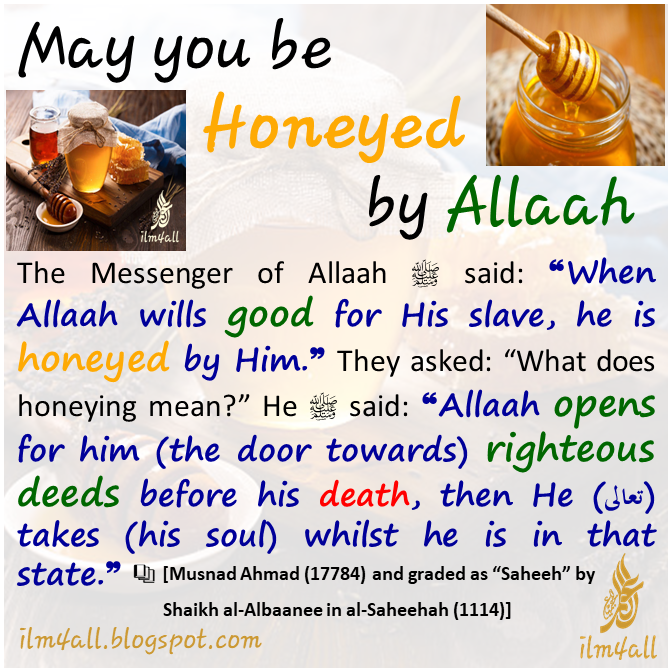
The Messenger of Allaah ﷺ said: ❝When
Allaah wills good for His slave, he is honeyed by Him.❞ They asked: “What does honeying mean?” He ﷺ
said: ❝Allaah opens for him (the door towards) righteous deeds
before his death, then He (تعالى)
takes (his soul) whilst he is in that state.❞
📚 [Musnad Ahmad (17784)
and graded as “Saheeh as per the condition of Imaam Muslim” by Shaikh
al-Albaanee in al-Saheehah (1114). Also graded as “Saheeh” by al-Haakim in
al-Mustadrak]
Another translation of the above Hadeeth:
❝When Allaah wills good for His slave, He (تعالى)
sweetens him.❞
They asked: “What is this sweetening?” He ﷺ said: ❝Allaah
opens for him (the door towards) righteous deeds before his death, then He (تعالى)
takes (his soul) whilst he is in that state.❞
HADEETH #2:
بسم الله والحمد لله والصلاة والسلام على رسول الله ، وبعد
Qataadah Ibn al-Nu`maan رضي الله عنه
narrated that the Messenger of Allaah ﷺ
said:
❝When Allaah loves a slave, He prevents him from the
world, just as one of you prevents his sick (relative) from water.❞
📚 [Sunan al-Tirmidhee (2036) and graded as “Saheeh” by Shaikh al-Albaanee. Saheeh Ibn Hibbaan (669) and graded as “Saheeh as per the condition of Imaam Muslim” by Shaikh Shu`aib al-Arnaoot]
🌴🌴🌴
📑 Explanation:
بسم الله والحمد لله والصلاة والسلام على رسول الله ، وبعد
🌟 Perhaps, on the Day of Judgment, a slave would wish that none of his supplications would have been answered in this world after seeing the reward he would be receiving on that Day for his unanswered supplications.
👉 Abu Sa`eed al-Khudree رضي الله عنه narrated that the Prophet ﷺ said: ❝There is no Muslim who offers a supplication - as long as he does not supplicate for something sinful or for severing of the ties of kinship - except that Allaah will give him one of three things in return for it: either He will hasten for him what he asked for, or He will store it [the reward for it] up for him in the Hereafter, or He will avert from him an equivalent evil.❞ They (the Companions) said: “Then we will supplicate a lot”. He ﷺ said: ❝Allaah is more generous.❞
بسم الله والحمد لله والصلاة والسلام على رسول الله ، وبعد
Whenever Allaah تعالى answers your prayers, then know that this is a favor from Allaah. And there is in it, help from Allaah, to keep you firm upon His obedience, and this is indeed a great honor.
Sometimes, a Du`aa is answered because of a reason involved, which acts as a catalyst, and which accelerates the response.
بسم الله والحمد لله والصلاة والسلام على رسول الله ، وبعد
وَلَا تَكُونُوا كَالَّذِينَ نَسُوا اللَّهَ فَأَنسَاهُمْ أَنفُسَهُمْ ۚ أُولَٰئِكَ هُمُ الْفَاسِقُونَ
{And be not like those who
forgot Allaah (i.e., became disobedient to Allaah) and He caused them to forget
their own selves, (let them to forget to do righteous deeds). Those are the
Faasiqoon (rebellious, disobedient to Allaah).}
[Surah al-Hashr (59):19]
بسم الله والحمد لله والصلاة والسلام على رسول الله ، وبعد
Abu Hurairah رضي الله عته said that the Messenger of Allaah ﷺ said: ❝When
the first night of Ramadhaan comes, the Shayaateen are shackled and mischievous
Jinns are restrained, and the gates of the Fire are closed, and none of its
gates remain opened. The gates of Paradise are opened and none of its gates remain
closed. And a caller calls out: “O seeker of good, proceed, O seeker of evil,
stop.” And Allaah has people whom He frees (from the Fire), and that happens
every day.❞
[Sunan Ibn Maajah (1642) and the wording is his, Sunan al-Tirmidhee (682), Sunan al-Nasaa’ee (2107) and graded as “Saheeh” by Shaikh al-Albaanee]
Explanation:
❝And a caller calls out…❞, meaning a caller (Angel) sent by Allaah عز وجل.
❝O Seeker of good, proceed❞, meaning: So, O seeker of good deeds and the one seeking rewards! This is the blessed month, come forward. In this, there is encouragement to increase in doing good deeds, because this is the time in which the means to do good deeds have been made easy, the paths have been cleared, and the Shayaateen have been confined. So, come forward, proceed towards Allaah, and proceed towards good deeds. The nobility of the time and place amplifies the reward, so don’t lag behind in doing good.
❝O Seeker of evil, stop❞, meaning: refrain from doing bad deeds in this blessed month, for this is the month in which one tries to purify the heart, stives to increase his Taqwaa, and persistently seeks Forgiveness from Allaah and His Mercy. So, stop your desires from chasing evil and train your self to be patient upon the obedience of Allaah, and turn to Allaah in repentance.
[Paraphrased from “Tanweer Sharh al-Jaami`
al-Sagheer (6/272)” and Mafaateeh Fee Sharh al-Masaabeeh (3/11-12)]